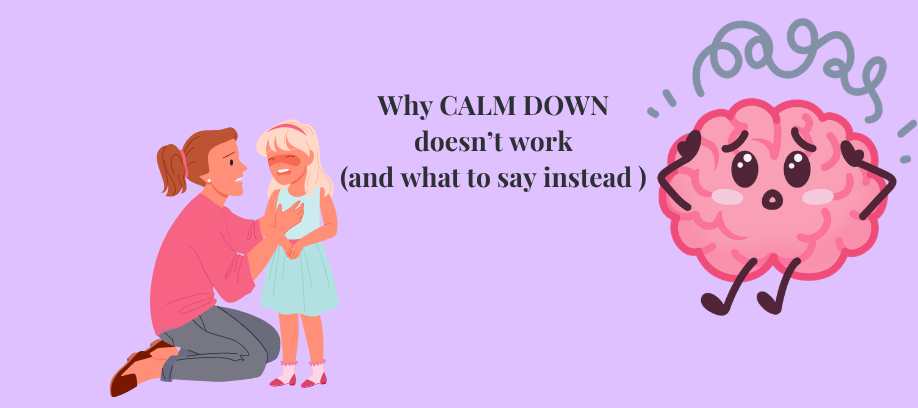
Why “Calm Down” Doesn’t Work (and what to say instead)
Your child is overwhelmed.
Emotions are running high.
They’re crying, yelling, or completely melting down.
And almost automatically, in complete good faith, out comes the phrase: “Calm down.”
But instead of helping… it often makes things worse.
The truth is, children cannot calm down through pressure.They calm down through connection, safety, and co-regulation. And there’s a real reason for that.
What’s actually happening in your child’s brain when emotionally overwhelmed
When a child is emotionally overwhelmed, the thinking part of the brain — the neocortex — effectively goes offline.
The emotional brain takes over. The amygdala, the part of the brain responsible for our fight-or-flight response.
And because a child’s neocortex is still developing well into their later years, they are far more vulnerable to being flooded by big emotions than we are as adults. It’s not defiance. It’s biology.
So when we say “calm down,” we’re essentially asking a nervous system in crisis to simply switch off. And that’s not how it works.
When a child is emotionally overwhelmed, they are not choosing to ignore you. They are not being dramatic, manipulative, or naughty. Their nervous system is genuinely struggling to find safety.
All this means that telling a child to ‘calm down’ can feel more like a demand than support. It doesn’t meet them where they are. Plus, kids borrow calm from regulated adults.
There’s something else worth noticing too. If you’ve ever felt your own voice tighten, your patience thin, or your frustration quietly creep in — that matters more than you might think. Children are sensitive, they pick up on the emotional state of the adults around them. They will pick up on your tension, even when you say nothing. And it can intensify their own.
This is why co-regulation is so powerful. Kids don’t just need instructions to calm down — they need to borrow calm from a regulated adult. Your steadiness becomes their steadiness. Your breath becomes their breath.
Before the words even come, what your child needs most is to feel your presence — and through that, their own sense of safety.
What children actually hear when we say “calm down”
Even when it’s said with the best intentions, “calm down” can land very differently than we mean it to. To a child already overwhelmed, it can mean something like:
- “Stop feeling.”
- “Your emotions are too much for me.”
- “You’re bad for reacting this way.”
They don’t feel corrected. They feel unseen and not understood.
What to Say Instead
There is no magic phrase — it’s about communication that signals safety. Here are some that work well:
“I’m here with you.” → safety
“I can see this feels really big.” → validation
“Let’s take a breath together.” → co-regulation
“You’re safe, it is ok to feel upset .” → nervous system reassurance
“We’ll get through this (or we will find a solution) together.” → connection
“Take your time, I am here with you.” → removal of pressure
And words are only part of it. Sitting close, offering a hand, a gentle arm around the shoulder — your physical presence speaks before any phrase does.
Pair that with a calm, soft voice, and don’t forget to pause and breathe for yourself too. Your body is sending signals just as much as your words are.
Children learn emotional regulation through co-regulation first. Before they can calm themselves, they need to experience someone calming with them.
And when does the correction or teaching happen?
Of course, children need to learn different things about life. In the right moment, though.
Certainly, when the storm has passed.
If the child is calm enough to actually hear you soon after, have the discussion, correct the behaviour, discuss the solutions, explain your decisions.
You know your child best. Some children might need more calm down time, some children recover quickly.
From my own experience, sometimes the most effective thing is to set the issue aside, do something totally different. Then, I come gently when we are both ready.
Sometimes the most effective thing is to gently set the issue aside, do something completely different together, and come back to it softly when you’re both ready.
And give yourself that same grace. You may need a moment to regulate too before you can show up the way you want to. That’s not weakness — that’s wisdom.
A Gentle Reminder for Parents and Caregivers
Most of us were never taught to sit with emotions — our own or anyone else’s. We were taught to stop them. Hide them. Push through them.
So if “calm down” has been your automatic response, please know: that is not a failure. It’s a pattern inherited from a time when emotional support simply wasn’t understood the way it is now.
Awareness is where change begins. And you’re already here, reading this, which means you’re already doing something different.
So, give yourself some grace. This is a gradual process. Give yourself time to be with your emotions. Allow yourself to feel what you feel without judgement.
Offer yourself some compassion.
You matter in this too. Not just as a parent or caregiver, but as a person who also has a nervous system, also has big feelings, and also deserves patience and kindness.
Change doesn’t happen instantly. But every moment of presence, every conscious breath, every time you choose connection over correction —change is happening.
It is a gentle process of change.
Want more practical tools to support your child’s emotional wellbeing?
Explore my Mindfulness for Kids page here for resources to help children feel calmer, safer, and more emotionally resilient.
Or if you’d like to try some co-regulation practices straight away, you can find a few gentle ones right here.