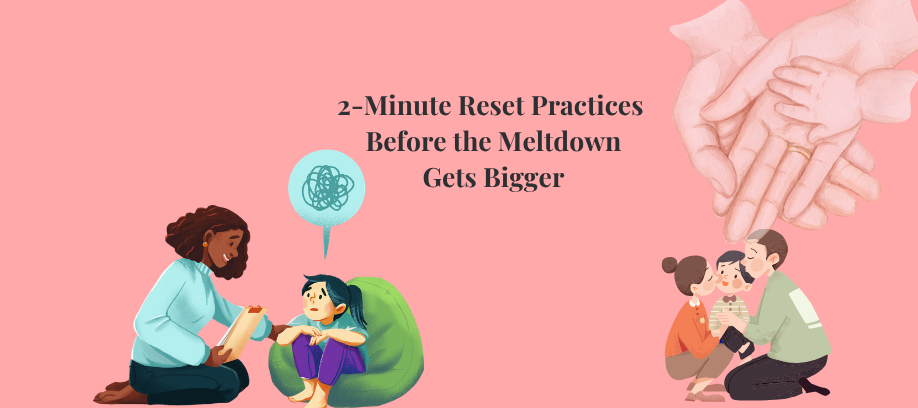
Try these 2-Minute Resets Before the Meltdown Gets Bigger
Connection Before Correction
It’s Monday morning, and you are already running late. As you try to get your child ready for childcare, they suddenly become overwhelmed by something as simple as getting dressed.
Big emotions arrive quickly. A tantrum follows.
These moments are part of parenting. But sometimes, just two minutes of calm connection can change the emotional direction of the entire morning.
When children are dysregulated:
- reasoning with them fails
- lectures fail
- connection works first
But how can you bring connection first when life feels so busy?
The good news is that you do not need hours. You do not need a perfect mindfulness routine either. Sometimes, just two regulated minutes can completely shift the emotional tone of the day.
In this article, I share three simple co-regulation practices to help you and your child bring more calm, connection, and emotional resilience into everyday moments.
Co-regulation is the process of helping a child calm their nervous system through our own calm presence, tone, and connection. Before children can fully regulate themselves, they first learn regulation through us.
Practice 1 — Stop • Soften • Breathe • Connect (SSBC)
This practice is simple to remember: SSBC
STOP
Pause the escalation.
SOFTEN
Relax your shoulders, jaw, and tone of voice.
BREATHE
Take 3 slow breaths together.
CONNECT
Offer eye contact, gentle touch, or a hug.
I personally recommend fewer words and more presence through calm touch and connection. If you feel it is important to say something, keep your voice soft and grounded.
You could simply say:
“I’m here. We can calm down together.”
Practice 2 — The 2-Minute Reset
This simple reset can help both you and your child feel safer and more connected.
The practice:
- Sit or kneel beside your child
- Put one hand on your heart and one on your belly
- Take 5 slow breaths together
- Name one feeling
- End with:
“We’re safe. I am here with you. We’ll figure this out together.”
One thing I always like to remember is:
“Naming a feeling helps tame a feeling.”
This helps children — and adults too — understand that emotions are safe to express, rather than something to fear or push away.
Practice 3 — The Traffic Light Calm Down
This practice works especially well for younger children because it is visual and easy to remember.
Use the three traffic light colours in this flow:
🔴 RED → Pause
No fixing. No lecturing.
🟡 YELLOW → Breathe
Take 3–5 slow breaths together.
🟢 GREEN → Connect
Ask:
“What do you need right now?”
or
“Can you name one feeling?”
You can finish with a hug, a gentle hand squeeze, or soft eye contact and a smile.
To make this even more practical for smaller children, you can create simple red, yellow, and green cards using coloured paper. Keep them somewhere accessible and use them as visual prompts during emotional moments.
I hope you find these 2-minute reset practices helpful.
Remember, every child is different. You may notice that one practice works better for one child than another. It also takes time for these tools to become part of your family rhythm and habits.
But over time, these small moments of connection can make a powerful difference — not only in calming difficult moments, but also in building a stronger long-term relationship with your child.
Co-regulation is not about getting rid of big feelings. It is about teaching children that they do not have to face those feelings alone.
When a child feels safe with you, the nervous system can begin to settle and reset.
Children borrow our calm before they can create their own.
Want more practical mindfulness tools to help children feel calmer, safer, and more emotionally resilient? You can explore my Mindfulness for Kids page here.
You can also explore more mindfulness activities with your children here
Mindfulness with Children – 5 activities you can practice with your children